

 English
 中文简体
中文简体 Español
Home / News / Industry News / What Makes Fluorozirconic Acid the Essential Backbone of High-Performance Materials?
Fluorozirconic Acid stands as a pivotal chemical compound, a critical intermediary that quietly drives innovation across a spectrum of advanced manufacturing sectors. Far from a commodity chemical, its unique properties allow it to serve as a foundational element in everything from high-definition optical glass to resilient metallurgical alloys. This feature explores the fundamental characteristics and expansive, high-stakes applications of this versatile liquid, focusing purely on its technical utility as an indispensable chemical component.
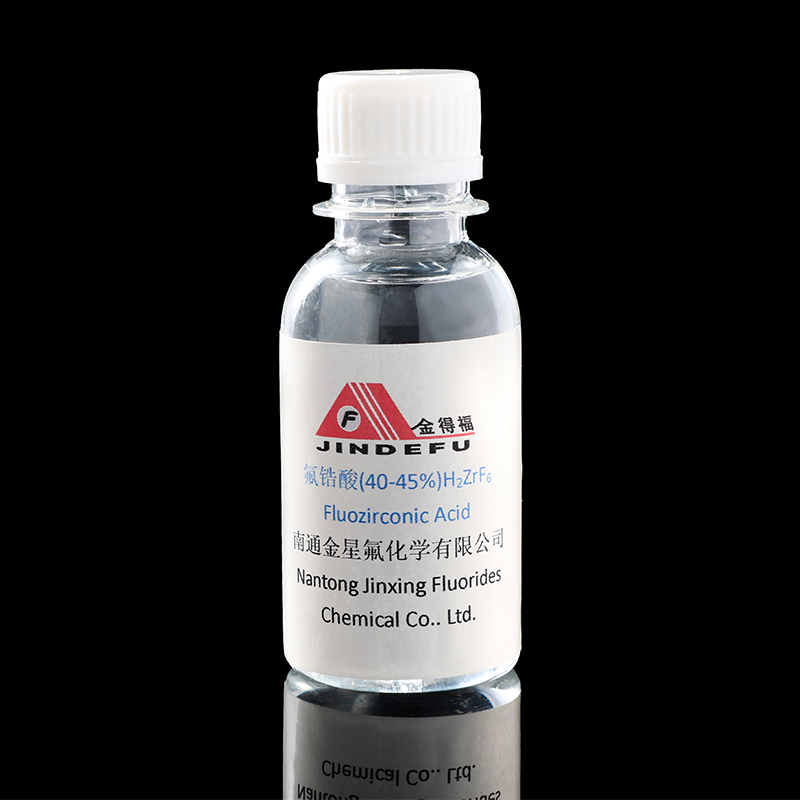
In its standard form, Fluorozirconic Acid (H₂ZrF₆) is characterized as a colorless, transparent liquid, a presentation that belies its powerful chemical reactivity and importance. This clear liquid state makes it highly manageable in controlled industrial processes, facilitating precise mixing and dosage in solution chemistry. However, its concentration level directly influences its physical stability. A key technical point is its tendency to precipitate or crystallize when its concentration exceeds 42% under ordinary temperatures.
This concentration-dependent stability necessitates careful handling and formulation in manufacturing, particularly when it is used as a raw material. Manufacturers must maintain specific concentration parameters to ensure it remains in its effective liquid state for optimal use as a reagent or precursor. The liquid form ensures maximum surface area contact and uniform distribution when used in plating baths, catalytic processes, or as a component in glass batches. This duality—powerful reactivity combined with a finely tuned stability threshold—is central to its wide-ranging industrial adoption.
A primary technical role of Fluorozirconic Acid is its function as a foundational raw material in the synthesis of a variety of specialized compounds, notably fluozirconates and fluotitanates. Zirconium compounds, in particular, are highly valued for their exceptional stability, resistance to heat, and unique electronic properties.
The acid's chemical structure provides a readily available source of the zirconium moiety (Zr) in a complex, soluble form, which is essential for creating high-purity downstream materials. Similarly, its application in the manufacture of fluotitanates and, subsequently, elemental titanium underscores its importance in high-strength, low-weight metal production. Titanium and its alloys are crucial in aerospace and medical devices, and the ability of Fluorozirconic Acid to act as a precursor aids in refining and preparing these critical elements for advanced use. This makes the acid a crucial upstream component for industries requiring the utmost material integrity and performance.
The metallurgical sector leverages Fluorozirconic Acid as a powerful agent in the production of specialty steels and non-ferrous alloys, particularly those involving magnesium and aluminum (magnalium). In these applications, the acid often serves two primary purposes: a fluxing agent and a means of introducing small, controlled amounts of zirconium into the metal matrix.
As an additive, zirconium, derived from the acid, can significantly refine the grain structure of metals, leading to improved tensile strength, reduced crack propagation, and enhanced corrosion resistance. This is particularly vital in the production of high-performance alloys used in structural components. Furthermore, its use in auto energy industry materials signifies its contribution to metals that must endure intense thermal and mechanical stress, such as components within electric vehicle battery casings or high-efficiency engine parts. The purity and controlled reactivity of the acid allow metallurgists to precisely dial in the desired material characteristics.
The acid is instrumental in manufacturing several high-performance non-metallic materials, especially in the realms of optics, ceramics, and fireproofing. Its use in the production of optical glass is essential for achieving lenses and components with specific refractive indices and low dispersion properties.
In the fireproofing domain, Fluorozirconic Acid serves as a raw component for flame-retardant treatments, often by creating stable, high-temperature resistant barriers when incorporated into materials. Furthermore, the acid is utilized in the intricate manufacturing of ceramics and enamel. The introduction of zirconium compounds can enhance the hardness, thermal shock resistance, and chemical inertness of ceramic glazes and body materials. These enhanced properties are critical for items used in harsh environments, making the acid a key enabler for advanced refractory and protective surfaces.
Beyond its major industrial contributions, Fluorozirconic Acid exhibits versatility in several highly specialized, smaller-volume applications:
Catalysis: It functions as an effective catalyst in certain chemical reactions. Its strong acidic and complexing nature allows it to drive or accelerate specific transformations, which is essential in the production of various organic and inorganic chemicals.
Senior Electrical Materials: As an electrical material precursor, it contributes to components requiring low electrical loss, high dielectric constants, or superior thermal stability—attributes necessary for modern electronic devices and advanced circuit boards.
Electro Vacuum Technology: Its role in electro vacuum technology materials highlights its use in specialized environments where low outgassing and high-purity components are mandatory, such as in the manufacturing of high-intensity discharge lamps or specialized scientific instruments.
Analytical Reagent: Due to its precise chemical composition and reactivity, it is employed as an analytical reagent in laboratories, aiding in the quantitative and qualitative determination of other elements.
Fireworks: Even in the pyrotechnics industry, zirconium compounds derived from the acid contribute to specific color effects and ignition compositions, demonstrating the compound's breadth of application.
The diverse and mission-critical applications of Fluorozirconic Acid confirm its status as an indispensable chemical component in the modern technological landscape. From enabling the structural integrity of high-grade steel and non-ferrous alloys to facilitating the clarity and performance of optical glass, its unique chemical properties—the ability to act as a stable, soluble source of zirconium—drive forward complex industrial processes. Its utility as an analytical reagent, a catalyst, and a foundational element for specialized electrical and fireproofing materials demonstrates a versatility unmatched by simpler acids. The precise management of its concentration ensures its effectiveness, confirming that this colorless liquid is a powerful, essential chemical workhorse in high-performance manufacturing.
Copyright © 2023 Nantong Jinxing Fluorides Chemical Co., Ltd. All Rights Reserved.
 Custom Fluorine Chemical Suppliers